

Darts Practice Routines To Try At Home
Throwing leg after leg of 501 against yourself is fun, but it is not the fastest way to improve. The players who get better quickly practise with a purpose, and work on the parts of the game that win matches - mainly scoring and finishing. Here are the darts practice routines that make a real difference for your performance, all of which you can do alone with just one board and three darts.
When you only play full games, you throw at the 20 most of the time and barely touch your doubles, then wonder why your finishing lets you down.
A good practice session flips that on its head by giving the weak parts of your game far more attention than they get in a match. After all, when it comes to improving your throw, twenty focused minutes is worth an hour of aimless throwing.
1. Around the Clock
Around the Clock is your classic warm-up, and a great accuracy builder as it forces you to aim all over the board - not just the corner you are comfortable with.
Work through every number from 1 to 20 in order, finishing on the bull. You must hit a number before moving on, and if you want to make this challenge even tougher, then only count trebles, or only doubles.
This darts drill is perfect for aligning your aim before you do anything else, so why not time yourself and try to beat it in your next session?
2. Treble 20 scoring
Scoring is built on the treble 20. There is no quicker way to lift your three-dart average than getting more skilled in hitting it, and the only way to do that is repetition.
Set yourself up at the oche and throw nothing but the treble 20 for a set number of darts - say 60 darts in a session - and keep a tally of how many treble 20s you hit. Write the number down each time, and then next week, try to beat it.
3. Doubles darts practice
This is the drill most players skip, but it’s also the one that wins the most legs. Pick your favourite double and throw 30 darts at it, counting your hits as you go. Then do the same on the two numbers either side, so you are never stuck if your favourite is blocked.
The more you have practised hitting a double in a quiet room, the calmer you will be when you need it to win a game.
4. Bob's 27
Bob’s 27 is a brilliant (yet slightly cruel) doubles game that every player should try. You start with 27 points and you throw three darts at double 1, then three at double 2, all the way up to double 20.
Each double you hit adds its value to your score, but here’s the catch: if you miss all three darts in a round, then that double's value is subtracted. The aim is to finish above zero, and ideally to set a personal best. It’s a drill that puts real pressure on every double and is addictive once it gets a grip on you.
5. 121 checkout practice
This sharpens the most important skill of all, which is finishing from a real match score. Start on a number you often face, like 121, and try to check it out in as few darts as possible, noting how many throws each try takes.
Work through a list of common finishes this way: 121, 101, 81, 61, 40. Remember that you’re training your brain to see the route instantly, and your hand to throw it, so that once these come up in a game, you will already know what to do.
6. Try the Quadro 240 board to hone your skills
Practising with the Harrows Quadro 240 sharpens your game in a way a standard board simply can't. Its four playing surfaces let you rotate the board regularly, so wear spreads evenly and your board lasts far longer between changes. The quadruple bed itself is smaller than on a standard board, so hitting it three times in a row demands real precision, making it a genuinely tougher test of your accuracy rather than a like for like practice tool. Push yourself to consistently find that bed and you'll notice the difference when you're back on a standard board in competition. For anyone serious about tightening their grouping, that added challenge is exactly what makes the Quadro 240 worth the practice time.
How to structure a 30-minute session
Only got 30 minutes for darts practice? Here’s how to make the most of your time:
- Warm up (5 min): Around the Clock to loosen the arm and find your aim.
- Scoring (10 min): Treble 20 reps, counting your hits.
- Finishing (10 min): Doubles practice or Bob's 27.
- Match play (5 min): One quick leg of 501 to put it all together.
Keep a record of your scores from each drill. Watching the numbers climb week on week is the best motivation there is, and it shows you exactly where to focus next.
Practise little and often
Remember that the arm learns through repetition, and repetition works best in regular doses.
Three short sessions a week will do far more for you than one long one, and twenty minutes most days will quietly transform your game over a couple of months.
Get the perfect practice setup
Practice makes perfect, and you will practise more if your setup is inviting.
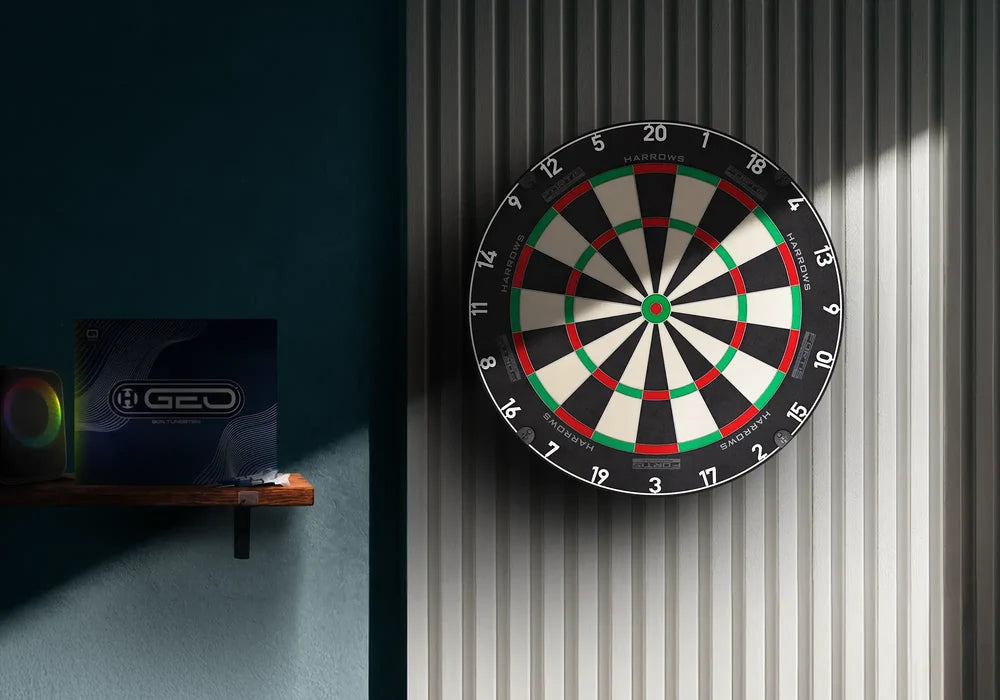
A well-lit, properly hung board makes every darts practice session better, especially if it heals over (like the Fortis) to withstand plenty of drills without wearing out. Good light cuts shadows and lifts your scores, so a Trilight is a smart addition, and a consistent dart from our Quick Point range lets you tune your setup as your game grows.
The board is waiting, so pick two drills, grab your dartboards and accessories, and start practising today.