

How Does Darts Scoring Work? The Board Explained
How Does Darts Scoring Work? The Board Explained
The dartboard looks busy at first glance. Twenty numbers, two thin rings, a circle in the middle and a lot of wire. Once you know what each part is worth, it all falls into place in about two minutes. Here is how scoring works, explained properly.
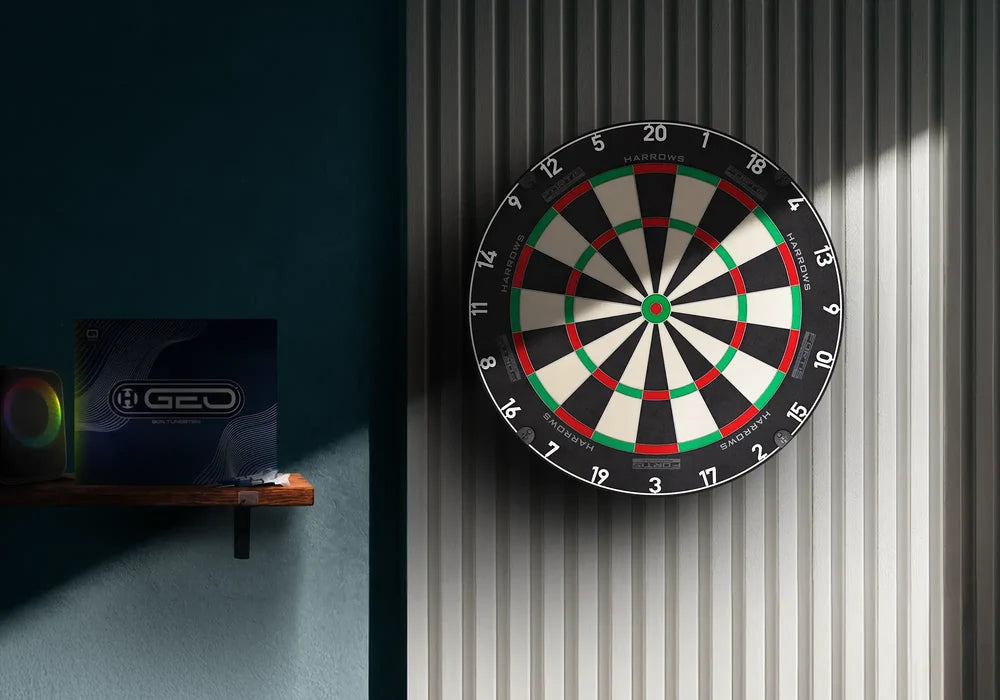
The layout
A standard board is split into 20 wedges, each with a number from 1 to 20 printed around the outside. The number tells you what that wedge is worth. Land in the 20 and you score 20. Land in the 5 and you score 5.
In the middle sits the bullseye, which is really two rings. The green outer ring and the red centre.
What each area scores
- Large single area: face value. A dart in the big part of the 19 scores 19.
- Outer thin ring (the double): twice the value. Double 20 is 40.
- Inner thin ring (the treble): three times the value. Treble 20 is 60.
- Outer bull (green): 25 points.
- Inner bull (red): 50 points.
- Outside the scoring area: nothing at all.
Notice that the treble ring sits inside the double ring, closer to the centre. That catches new players out. The treble is the more valuable of the two, and it is the thin band roughly halfway between the bull and the outer edge.
The highest scores
Treble 20 is worth 60, which is the most any single dart can score. Three of them makes 180, the maximum for a three dart visit. That is the number you hear a crowd roar at.
The bullseye is worth 50, so it is not actually the best score on the board. Plenty of beginners aim for the bull thinking it is the jackpot. In a scoring game you are far better off working the 20.
Where the dart counts from
Your score is decided by where the point of the dart lands, not where the flight ends up. If the point is in the treble, it scores the treble, even if the dart is leaning at an odd angle.
A dart only counts if it stays in the board until you collect it. If it drops out or bounces off, it scores nothing, and you do not get to throw it again.
Adding up a visit
A turn is three darts, called a visit. You add the three together for your total.
Say you throw a treble 20, a single 20 and a single 5. That is 60 plus 20 plus 5, which makes 85. In a game of 501 you take that 85 off your score.
Most scoring happens around the 20 for the obvious reason. If you miss the treble you usually still land in the single 20, so a bad dart is not a disaster.
Why the numbers are arranged the way they are
The layout is not random. High numbers sit next to low ones on purpose. The 20 has the 1 and the 5 either side of it. The 19 sits between the 3 and the 7.
This punishes a slightly wayward dart. Miss the 20 by a fraction and you score 1 or 5 instead of 60. That is the design working exactly as intended, because it rewards accuracy rather than brute force.
The 25 and the 50
Some scoring systems and older score sheets write the outer bull as 25 and the inner as 50. You will sometimes hear players call the outer bull "twenty five" and the inner "the bull" or "double bull".
The inner bull counts as a double when you are finishing a leg. That is worth knowing, because it means you can check out 50 with a single dart.
Keeping score in a game
In 501 you start on 501 and subtract each visit. So the maths runs downwards, not up. Score 100 and you are on 401. Score 140 next and you are on 261.
The one catch is that you must finish exactly on zero with a double. There is more on that in our guide to getting started, and a scoreboard on the wall makes the sums much easier when you are playing with friends.
A quick practice tip
The fastest way to learn the board is to throw at every number in turn, working from 1 up to 20. You will know where everything sits within a few sessions, and you will stop hunting for numbers mid-game.
A quality board makes that practice more pleasant, because a good surface holds the dart and heals over when you pull it out. Have a look at the Fortis dartboard or browse the full dartboards range.
The short version
Singles score face value, doubles score twice, trebles score three times, the outer bull is 25 and the inner bull is 50. Treble 20 is the big one at 60. Learn those and you can score any game of darts going.
Ready for a set of your own? Our best darts for beginners are an easy place to start.