

Article: How to Stop Darts Bouncing Out
How to Stop Darts Bouncing Out
How to Stop Darts Bouncing Out
Few things in darts are as annoying as a good dart hitting the board and dropping straight out. It scores nothing, and you do not get to throw it again. The good news is that most bounce-outs have a cause you can do something about. Here are the usual suspects.
Cause 1: blunt or damaged points
This is the first thing to check, and it fixes more bounce-outs than anything else on this list.
A sharp point bites into the sisal. A blunt or rounded one skids off. Points go blunt faster than people expect, particularly if you play on a hard floor where dropped darts land tip first.
The fix. Inspect your points. Run a finger over the tip. If it feels rounded or you can see a flattened end, it is costing you darts.
You can dress a point back with a sharpening stone, but do not make it needle sharp. An overly sharp point splits the sisal fibres and damages the board. You want the tip slightly rounded, like the end of a pencil that has been used a little. That grips without cutting.
If a point is bent or badly worn, replace it. Our Quick Points screw in and out, so swapping takes seconds. There are also fixed options in the steel tip points collection.
Cause 2: hitting the wire
Sometimes the dart is fine and the board is the problem.
Older boards use thick round wire held in place with staples. There is a lot of metal for a dart to hit, and when it does the dart pings straight back out. Modern boards use thin blade wire set flush into the surface, so there is far less to catch.
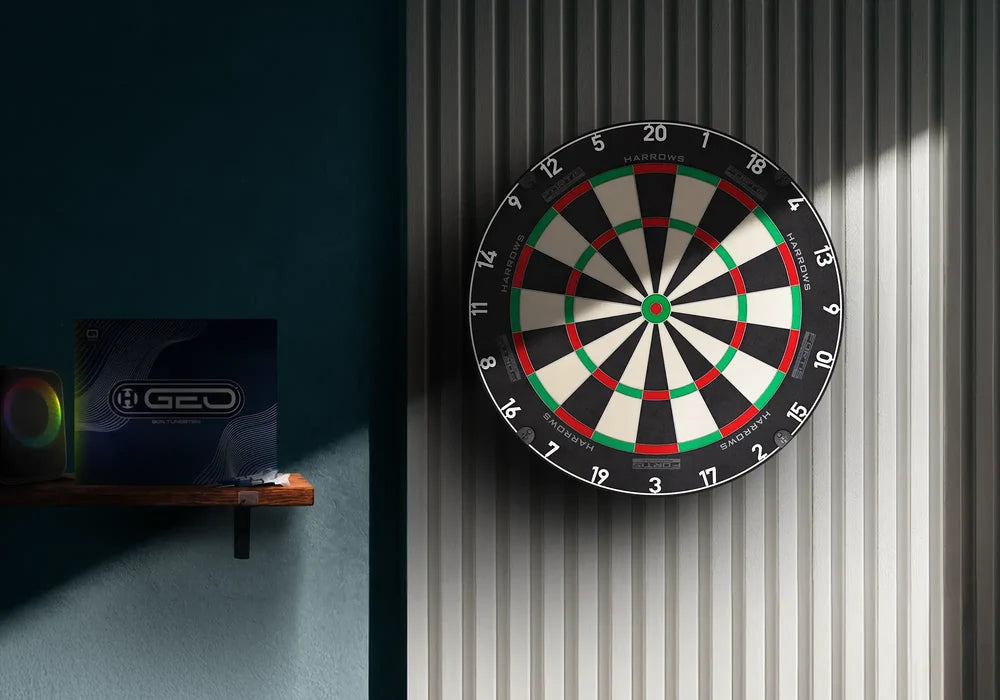
The fix. If you are throwing at an old board with thick wiring, that is very likely your issue. A board with thin blade wire and a staple-free bullseye will cut bounce-outs noticeably. The Fortis is built this way, and you can compare the range in our dartboards collection.
Cause 3: a worn out board
Sisal heals over when you pull a dart out, but it does not last forever. Most of your darts land in the 20, so that segment wears first. Once the fibres break down, the surface stops holding darts.
The fix. Rotate the board. Most quality boards have a removable number ring so you can move a fresh segment to the top every few weeks. This spreads the wear and adds years to the board's life.
If your 20 bed is visibly chewed up and rotating no longer helps, the board has had its day.
Cause 4: a dry board
Sisal needs a little moisture to stay springy. A board kept in a very dry room, or right next to a radiator, will dry out and go brittle. Brittle fibres do not grip.
The fix. Keep the board away from direct heat and out of direct sunlight. Do not soak it, which is old advice that does more harm than good. Just avoid the extremes.
Cause 5: your darts are landing flat
A dart that arrives nose up or perfectly flat has less chance of biting than one that arrives at a downward angle.
The fix. Look at how your darts sit in the board. If they are pointing upwards, the throw is arriving too flat. A more front weighted barrel, such as a torpedo or bomb shape, can help pull the nose down. A shorter shaft or smaller flight will also flatten the angle less.
You can filter the steel tip darts collection by shape to compare, or experiment cheaply first with different shafts.
Cause 6: crowding
Sometimes the bounce-out is a compliment. Your first dart is already sitting in the treble, and the second one hits it.
The fix. A slimmer barrel takes up less room, which gives your other darts somewhere to go. That is the practical argument for higher tungsten content. A 90% barrel is meaningfully slimmer than a brass one at the same weight, and our Wolfram Trinity 97% is slimmer again.
Shorter barrels help too. Bomb shapes are popular partly for this reason.
Cause 7: throwing too hard
A dart hammered into the board with real force is more likely to hit wire and rebound, and more likely to knock other darts out.
The fix. Smooth beats fast. You need enough pace to carry the dart cleanly, not enough to dent the wall behind. If your darts are burying themselves and vibrating, ease off.
Quick checklist
- Check your points are sharp but not needle sharp.
- Rotate the number ring so the 20 gets a rest.
- Move the board away from radiators and direct sun.
- Replace an old board with thick wiring.
- Ease off the power.
- Consider a slimmer or more front weighted barrel.
Work through those and the bounce-outs will drop away. Some are unavoidable, but they should be rare rather than routine.